Subterranean termite soil treatment creates an unbroken, undetectable zone of termiticide saturated into the earth surrounding a structure. Subterranean species nest in damp subsoil beneath foundation footings and…
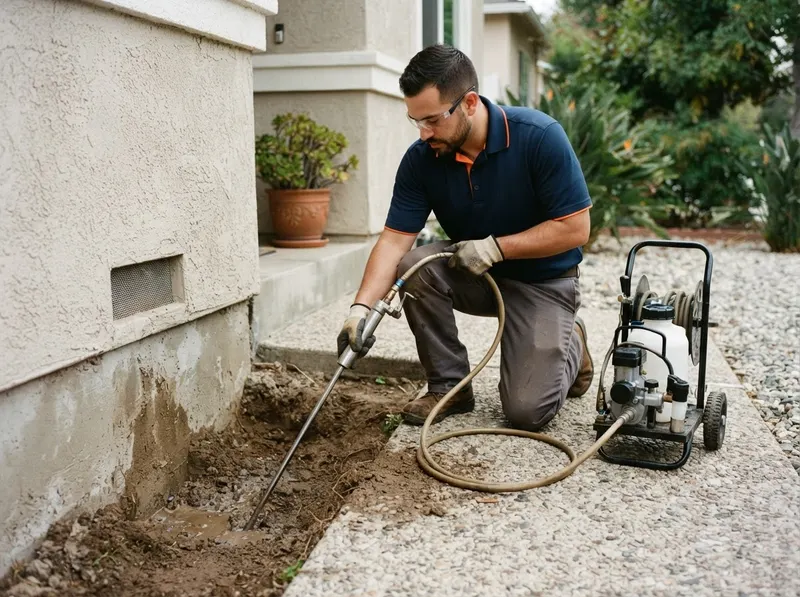
Subterranean termite soil treatment creates an unbroken, undetectable zone of termiticide saturated into the earth surrounding a structure. Subterranean species nest in damp subsoil beneath foundation footings and construct shelter tubes out of digested cellulose, soil, and saliva to bridge masonry barriers. When untreated soil contacts structural mudsills, colonies compromise structural load capacities from the bottom up. Liquid barrier soil applications adhere to standards documented by the California Department of Pesticide Regulation, prioritizing persistent active ingredients like fipronil over short-lived repellant sprays. Structural installations in clay soils common to Los Angeles County demand high-pressure vertical rodding alongside foundational footers to saturate subterranean galleries without causing foundation heave.
Subterranean termite pressure varies substantially across microclimates throughout Southern California. Coastal moisture in Venice and San Pedro sustains elevated groundwater tables that accelerate subterranean mud-tube propagation along stem walls. Inland basin conditions in Encino and Sherman Oaks produce cracked, expansive adobe clay during heat spells, creating natural subsurface fissures that guide subterranean colonies directly into slab joints. Hillside footings across Silver Lake, Echo Park, and Los Feliz feature stepped stem walls where surface runoff can erode thin surface sprays; these foundations require mechanical trenching down to 6 inches alongside masonry footers to anchor the non-repellent barrier according to guidelines from the California Structural Pest Control Board.
Soil treatment serves a fundamentally different structural role than localized spot treatments or structural wood replacements. Surface foaming treats isolated framing bays but leaves subterranean ground colonies intact to target adjacent wood members. A continuous barrier treatment envelopes the entire foundation footprint, ensuring foraging workers cross into non-repellent zones and distribute the active ingredient back to the reproductive queen via grooming behaviors outlined by the USDA Agricultural Research Service. For architectural slabs in Koreatown and Brentwood, drilling access holes at 12-inch intervals through exterior concrete pathways delivers the necessary 4 gallons per 10 linear feet mandated by standard structural protection practices. This engineering-focused subterranean soil barrier eliminates subterranean infiltration without relying on intermittent inspections or wood replacements alone.
Execution follows an exact sequence to secure compliance with EPA pesticide safety standards and structural integrity principles: 1. Perimeter inspection pinpoints subterranean shelter tubes and utility conduit intersections along the stem wall. 2. Technicians excavate continuous 6-by-6-inch soil trenches against exterior foundation concrete. 3. Sub-slab injection rods pump liquid termiticide at designated volume ratios into masonry cracks and slab expansion joints according to the USDA Natural Resources Conservation Service soil guidelines. 4. Trench backfill soil receives uniform saturation before final mechanical tamping. 5. Concrete core penetrations are sealed flush using non-shrink hydraulic cement meeting ASTM International construction specifications. Ongoing building code integrity aligns with criteria established by the Los Angeles Department of Building and Safety, the National Pest Management Association, structural research from the UC Statewide Integrated Pest Management Program, and municipal guidelines managed by the County of Los Angeles.
Every job gets a firm, written price after a free on-site visit.
For standards, safe disposal, and service guidance on pest control services in Los Angeles, CA, useful references include U.S. EPA, ENERGY STAR, U.S. Dept. of Energy, Consumer.gov, U.S. Census Bureau, and Google Maps. General consumer and small-business resources are available from USA.gov, Better Business Bureau, FTC Consumer Advice, U.S. Small Business Administration, and Ready.gov.
Tell us about your subterranean termite soil treatment job in Los Angeles and we'll send a clear, written quote, usually the same day.
 DiamondEdge Pest Defense