Commercial kitchen bioremediation provides permanent containment where standard surface cleaning fails. Food production facilities across Los Angeles face severe pest pressures when organic debris settles under tile…
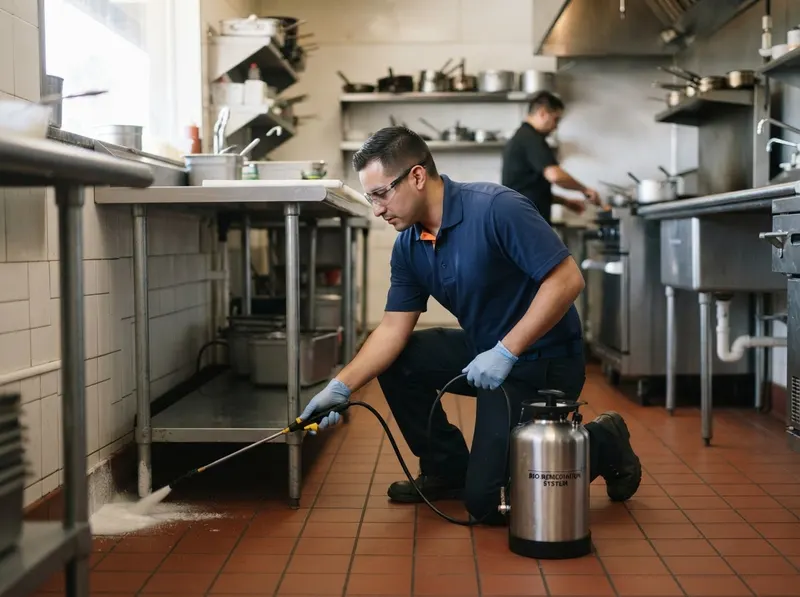
Commercial kitchen bioremediation provides permanent containment where standard surface cleaning fails. Food production facilities across Los Angeles face severe pest pressures when organic debris settles under tile flooring, around beverage station drains, and throughout sub-slab piping. Traditional mop cycles wash emulsified cooking oils into grout lines, creating feeding reserves for the German cockroach (Blattella germanica) and nesting zones for phorid flies (family Phoridae). Rather than relying on standard pesticide sprays that break down in warm environments, DiamondEdge Pest Defense installs vegetative bacteria colonies that digest fats, oils, and grease down to carbon dioxide and water, removing the core biological attraction.
Dense dining corridors along Wilshire Boulevard in Koreatown and beachfront establishments facing coastal humidity in Venice face strict compliance standards enforced by the Los Angeles County Department of Public Health. Kitchen floor drains, beverage trench lines, and mop sink basins accumulate compacted scum mats measuring 0.5 to 2 inches in depth. When facilities try to eradicate persistent insect populations using pyrethroid sprays, chemical drift contaminates active prep tables without penetrating subterranean drain lines. Bioremediation solves this by applying non-pathogenic, spore-forming bacterial strains certified under the EPA Green Chemistry framework. These enzymes liquefy solid food films behind equipment bases and inside drain traps where heat and running water cannot wash them away.
Structural layout dictates whether a property requires drain line bioremediation or localized deep-floor enzyme treatments. Small-footprint cafes along Sunset Boulevard in Silver Lake and Echo Park with single-bay prep sinks usually resolve fly outbreaks through targeted 4-inch drain injections and under-counter baseboard applications. High-volume dining operations along Ventura Boulevard in Sherman Oaks and Encino operating multi-pan fryers require pressurized, continuous-dosing microbial pumps coupled with full grease-trap bio-flushing. DiamondEdge Pest Defense verifies pipe interior walls before and after treatment, ensuring clear plumbing lines without caustic sodium hydroxide compounds that degrade municipal municipal sewer ties governed by the LA Sanitation and Environment division.
Bioremediation delivers complete pest exclusion by systematically eliminating food reservoirs in high-risk multi-tenant structures in Boyle Heights and Los Feliz, as well as institutional dining halls in Brentwood and dockside facilities in San Pedro. Chemical perimeter traps serve merely as monitoring stations until sub-tile organic deposits are completely consumed. The process requires 3 distinct steps: 1. Complete mechanical scraping of drain covers to dislodge top-layer fibrous mats; 2. Low-pressure application of spore-based foam into drains and under equipment footings to penetrate voids; 3. Inoculation of trunk plumbing lines to establish thriving biological colonies that continue digesting organic debris for 30 days.
Every job gets a firm, written price after a free on-site visit.
For standards, safe disposal, and service guidance on pest control services in Los Angeles, CA, useful references include U.S. EPA, ENERGY STAR, U.S. Dept. of Energy, Consumer.gov, U.S. Census Bureau, and Google Maps. General consumer and small-business resources are available from USA.gov, Better Business Bureau, FTC Consumer Advice, U.S. Small Business Administration, and Ready.gov.
Tell us about your commercial kitchen bioremediation job in Los Angeles and we'll send a clear, written quote, usually the same day.
 DiamondEdge Pest Defense