Subterranean moisture dynamics in Southern California directly dictate subfloor pest vulnerability. Crawlspace encapsulation operates as a non-chemical mechanical shield, separating subterranean insect vectors from the…
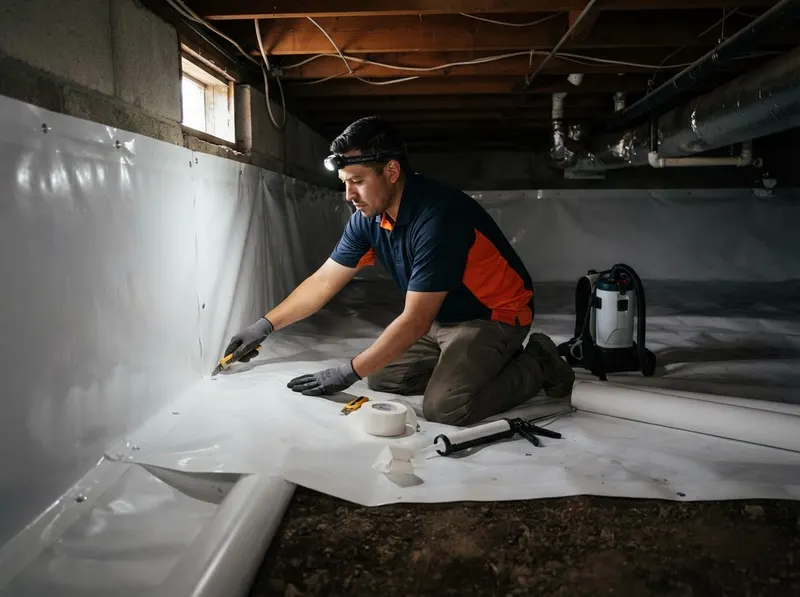
Subterranean moisture dynamics in Southern California directly dictate subfloor pest vulnerability. Crawlspace encapsulation operates as a non-chemical mechanical shield, separating subterranean insect vectors from the structural timber of residential foundations. High ambient moisture in coastal basins such as Venice and San Pedro forces humidity levels in raised foundations above the 70% threshold required for wood-decay fungi and structural colonizers to thrive, as recognized by the U.S. Department of Energy. The primary barrier is an unyielding high-density polyethylene membrane anchored across the soil bed and sealed against concrete stem walls with polyurethane adhesives. This physical cutoff denies subterranean termites the ground-moisture conduit they require to construct shelter tubes into floor joists. Unlike topical broadcast insecticides that degrade under persistent ambient humidity, continuous mechanical barriers provide continuous protection without requiring chemical reapplication cycles.
In older properties across Los Feliz, Silver Lake, and Echo Park, historic raised foundations feature vented crawlspaces designed under outdated ventilation codes. Modern building sciences published in the HUD Office of Policy Development and Research confirm that unconditioned vents actually pull damp marine air into the crawlspace rather than expelling it. This relative humidity differential generates heavy subfloor condensation, attracting oriental cockroaches and silverfish seeking microclimates above 60% relative humidity. During encapsulation, technicians seal foundation vents using corrosion-resistant hardware cloth compliant with CalRecycle standards for waste management and building longevity, paired with mechanical closures evaluated under the International Code Council guidelines for closed crawlspaces. To regulate inner ambient air without drawing exterior humidity, technicians integrate commercial low-temperature dehumidification systems sized according to ASHRAE standard ventilation metrics.
Subfloor defense in hillside corridors like Brentwood and Sherman Oaks encounters aggressive rodent vectors, specifically roof rats and Norway rats, which exploit unsealed dirt foundations to tunnel underneath mudsills. DiamondEdge Pest Defense reinforces soil-level vapor retarders with 1/4-inch 23-gauge galvanized steel mesh along footing transitions, halting vertical rodent intrusion before nesting burrows can compromise perimeter electrical lines or fiber sub-insulation. In clay-heavy regions throughout Encino, Koreatown, and Boyle Heights, seasonal shifting causes soil moisture fluctuations that degrade bare wood framing over time. By incorporating sub-membrane drainage channels tied into gravity discharge paths regulated by the Los Angeles Regional Water Quality Control Board, our technicians isolate structural foundations from standing groundwater. This installation procedure strictly adheres to structural clearance guidelines set by the California Structural Pest Control Board, ensuring wood components maintain uninhibited inspection access.
Material specifications require strict compliance with ASTM E1745 Class A vapor retarder ratings to resist puncturing from sharp soil debris and maintain water vapor permeance ratings below 0.01 perms. By sealing out soil vapors and external relative humidity, homes experience direct mitigation of damp rot and eliminate micro-environments that sustain moisture-seeking pests. The structural exclusion methods deployed throughout Los Angeles County protect internal subfloors, ductwork, and structural footings from degradation caused by wood-boring pests and burrowing rodents without contaminating adjacent municipal storm systems monitored by the U.S. Environmental Protection Agency.
Every job gets a firm, written price after a free on-site visit.
For standards, safe disposal, and service guidance on pest control services in Los Angeles, CA, useful references include U.S. EPA, ENERGY STAR, U.S. Dept. of Energy, Consumer.gov, U.S. Census Bureau, and Google Maps. General consumer and small-business resources are available from USA.gov, Better Business Bureau, FTC Consumer Advice, U.S. Small Business Administration, and Ready.gov.
Tell us about your crawlspace encapsulation and moisture barrier defense job in Los Angeles and we'll send a clear, written quote, usually the same day.
 DiamondEdge Pest Defense